The Vintage Halloween Pieces Worth Digging Out Again
The heyday of these collectibles runs from the 1920s through the 1950s and 1960s, and the best examples still turn up at estate sales, in family attics, and online.
Below are the categories most worth seeking out, what they cost, and how to work them into a room without the result reading as a jumble.
1. Paper Mache Lanterns
Why they deserve the comeback
Paper mache lanterns were inexpensive, cheerful items made to light up, and most were shaped like pumpkins, though some came as cats and other Halloween themes.
Many featured paper inserts for their faces — the toothy grins and off-kilter eyes that define the look. Their glow is softer and warmer than anything a plastic bucket produces.
Where to buy
These lanterns sell on eBay and carry guide values of roughly $75 to $150 depending on condition. The same material also went into candy containers and nut cups, so a seller listing one often has related pieces.
Budget tip
If an original lantern is out of range, look for reproduction jack-o'-lantern buckets with cracked, hand-painted finishes. Grouped with a real piece, they blend in and cost a fraction.
2. Halloween Postcards
Postcards spread widely as a Halloween staple in the late 1800s and remain one of the most collectible Halloween items.
Most showed illustrated scenes of festivities — bobbing for apples, fortune games, witches, pumpkins, and cats.
The verses printed on them are half the appeal, from "Beware! The time is here in which the witches do appear" to a longer fortune-telling rhyme about "jack-o-lanterns burning bright".
Postcards start around $10 to $20 and climb into the hundreds for rare, mint, unused cards. Some of the more popular ones carry an artist's signature, with Clapsaddle and Brundage among the best-known names. Some also gain value from writing on the back that references Halloween parties.
Styling tip
Frame a small set as a haunted gallery wall. Postcards pair well with framed Ouija boards and grinning black cats for a wall that reads as collected over time.
3. Tin and Paper Noisemakers
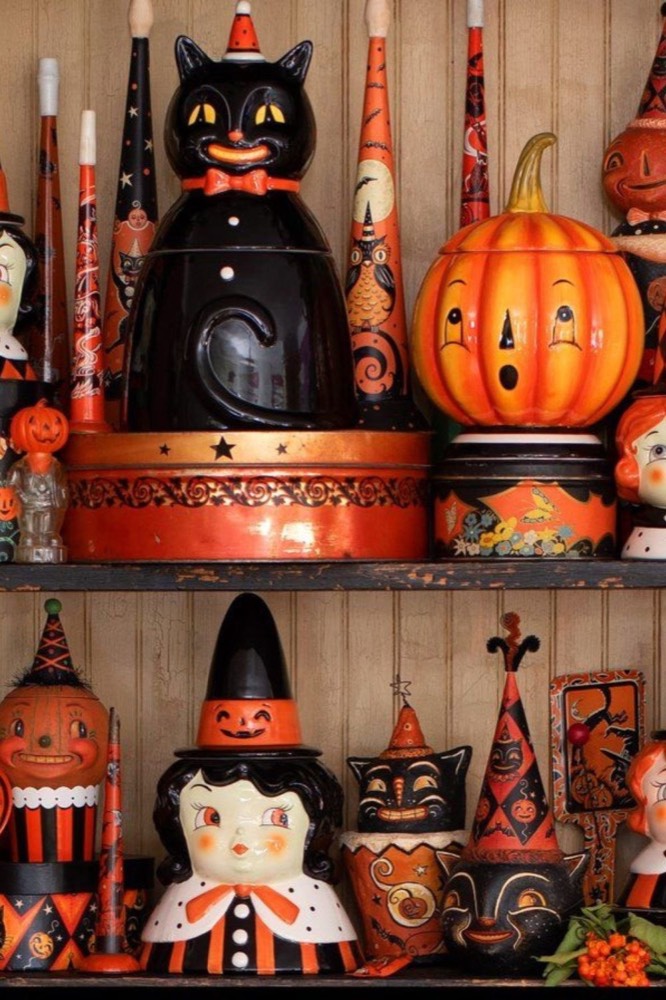
Noisemakers were fun, inexpensive toys in every style, stamped with the familiar cast of witches, cats, ghosts, pumpkins, owls, and devils.
They ranged from paper to metal, and the earliest metal ones had wooden handles later replaced by plastic — a useful clue for dating a find.
Prices generally run from about $15 to $75, with scarce examples reaching into the hundreds depending on age, maker, and imagery. Look for names like Kirchhof, T. Cohn, Bugle Toy, US Metal Toy, and J. Chein and Co.; a number of these also originated with German producers.
DIY tip
Noisemakers photograph well but do not need a case. Line a few along a shelf with weathered pumpkin lanterns, cat figures, and ghosts so the group reads as collected rather than curated.
4. Vintage Pumpkin Figures
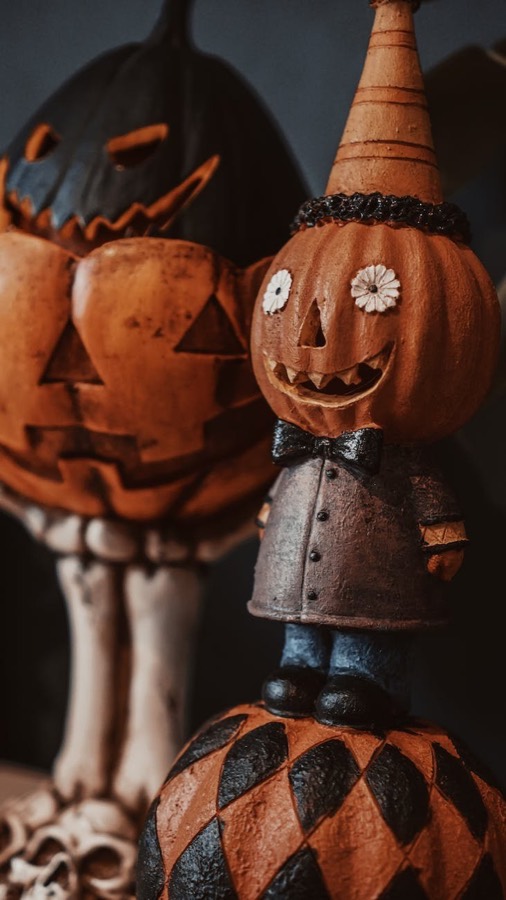
Small pumpkin figures painted with faces bring instant nostalgia to a display. The chipped paint and plain shapes do most of the work.
Original figures surface at estate sales and antique shops. For new work in the old style, Johanna Parker creates vintage-style Halloween pieces that share the same weathered look.
Use three to five figures total and place them at eye level on a console, mantel, or sideboard. A black cat and a skull set alongside the group keep the display looking gathered rather than cluttered.
5. Old Dolls
Grouped in one spot, old dolls take on a quiet, faintly eerie charm.
Their worn faces and faded clothes signal Halloween on their own, with no need for bright color or obvious props — a subtler route than the usual orange-and-black.
Dolls are easy to thrift if you do not already own any. Almost any secondhand shop carries them, and worn condition is an asset here rather than a flaw.
Set the dolls in a plain wooden crate, arrange a few black pumpkins around the base, and let dried branches climb up from behind. A long table suits the arrangement best, with the crate anchoring the whole scene as the single focal point.
6. Crepe Paper Costumes and Party Books
Many vintage costumes were sewn by hand out of crepe paper and usually thrown out after Halloween, which makes surviving examples scarce.
The Dennison Paper Company's Bogie Books were full of costume ideas, recipes, and party-planning notes, while Beistle party books included invitations, place cards, candle shades, and nut cups.
Manufactured costumes from makers like Collegeville, Ben Cooper, and Halco are among the most commonly found vintage Halloween costumes.
For guidance on identifying and pricing any of these, Mark Ledenbach's guide, "Vintage Halloween Collectibles," is a standard reference.
Most Halloween collectibles run from about $20 to $300, so party ephemera like place cards and diecuts is an affordable way in. Displayed on a shelf, these small pieces stay in view and easy to rotate season to season.
7. Blow Mold Figures
Retro blow molds are the plastic figures once used to light neighborhood sidewalks.
They typically feature witch, cat, and pumpkin shapes that glow in neon colors — brighter and more playful than the muted paper pieces, and a bridge between the earliest collectibles and mid-century Halloween.
Blow molds show up at yard sales and online marketplaces, often for less than paper collectibles of the same age because they were produced in volume. Condition and working light sockets matter most to value.
Blow molds suit a porch better than a mantel. Set one near a standing skeleton by the front door with carved pumpkins around the steps to build a scene that feels pulled from old photographs.
Bringing It All Back
Vintage Halloween décor embraces a maximalist spirit that is spooky, cozy, and atmospheric, built on the black-and-orange palette with its black cats and full moons.
Some displays swap that palette for burnished gold, fall leaves, and warm string lights instead.
Whichever direction you take, the trick is restraint within abundance: group a few strong pieces, let the worn surfaces speak, and place old fabric underneath an arrangement so it reads as a found collection rather than something staged.
These objects survived because people kept them. Putting them back on display is the simplest way to keep them working.